Friday, March 25, 2016

The Happy Vacationers (Gli Allegri Vacanzieri) and Tomato Sauce


Children breathing in the requisite mountain air.


When we arrived in Cerro Veronese at the end of May, the houses nearby were vacant.  But in July the population of the village quintupled.  There was increased traffic, people and noise.  The ubiquitous scooter could be heard zipping up and down our hill day and night. Italians believe that for children to grow strong and healthy, they need to spend a month in the mountains and a month at the seaside each summer.  Their lungs need the purified air of the mountains and the salty breezes of the sea. Considering Italy’s geography and topography, this goal is relatively easy to accomplish.


I was thrilled when Maria appeared in the house across the lane.  She had golden curls piled on top of her head, big brown eyes, big hoop earrings and red, red lips that were always smiling.  She heralded me from her balcony one day, a plump baby in her arms. Together we went on walks up the hill and down and up into the village.  Maria was staying in her in-laws cottage.  She was there alone the first few weeks and we became friends.  Once her mother-in-law arrived, she was less available.


One day, I went over to her house with the children.  While they entertained her baby, she taught me how to make gnocchi and basic tomato sauce.  I don’t often make the gnocchi these days but I still remember the tomato sauce. It’s easy and tasty.

SUGO AL POMODORO

In a large sauce pan put:
A large can of plum tomatoes. (San Marzano tomatoes are probably best)
A stalk of celery
A large carrot cut in pieces
A medium onion cut in large pieces.
A chicken bouillon cube.

Bring to a boil and then simmer gently for a half hour to forty-five minutes to an hour?
Put through a Moulinex food mill or a food processor.  I like to keep it a little thick. 

Taste and add salt and pepper as you like.  Sometimes a teaspoon of sugar does the trick.  And of course you could add some tasty herbs while it’s cooking!

Thursday, March 24, 2016

Red Poppies and Communism


The children had been enrolled in the nursery school for only a couple of weeks, when they told me they had been invited to a birthday party.  At first I didn’t believe them.  How could they understand a possible invitation when they spoke practically no Italian. When did they learn the word “compleanno" (birthday)and who would have invited them?   
    
Later when we got home a woman with three children showed up at the gate.  Her name was Gabriella.  I’ve forgotten her last name and the name of the children.  Gabriella, her husband and her brood lived in a chalet above us on the hill.  The house was large and comfortable. The windows of the spacious living room framed the snow-covered mountains in the distance.   We were indeed invited for cake and juice the next afternoon.  It was the middle daughter’s birthday.  The kids had been playing together at school.


My children were excited and I was thrilled to make a friend and attend a social event.  The cold, rainy days had been long for Christopher and me.  We had few toys and it wasn’t possible to spend time outside.

Me, Charles,  Gabriella's husband, Gabriella and family on their balcony.


Gabriella and her husband were staunch Communists.  They fully believed in the Marxist doctrine.  It was incredible to me, because they were the poster children for a capitalistic success story.  Together they had grown a small chicken and egg business into a thriving affair.  They sold the eggs and when the hens were no longer producing at an acceptable rate, they sold them for meat.  I believe this sort of production was new at the time;  this was long before Perdue and Tyson.

One day we were invited to visit the chicken coops.  We met at the old abandoned farm house.  I was offered an espresso with grappa which I declined.  Then we headed for the long buildings that housed the chickens. The hens were squeezed into tight pens.They all wore tiny blinders so they couldn’t see each other and peck at each other.  A conveyor belt rolled along in front with grain for the chickens. Another conveyor belt carried away the feces.   The children helped gather the eggs. I helped Gabriella with a new shipment of baby chicks. Each one had to be picked up and held firmly while eyedrops were inserted in each eye. I can still recall in horror the smell, the racket and the inhumane treatment of those poor chickens.

What horrors lay ahead for this little chick?


See the temple on top of our hill?  It was a favorite place to play.

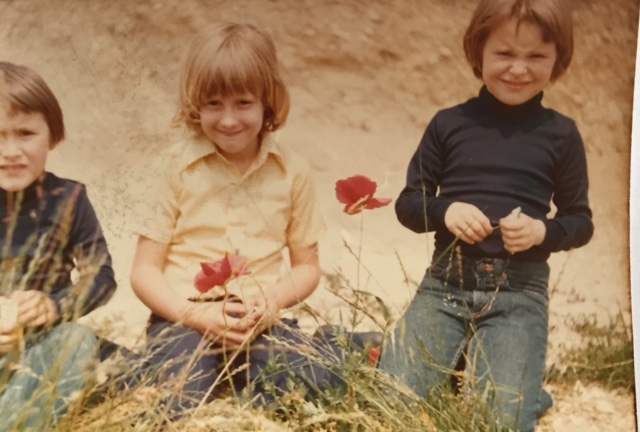
Sometimes when the weather was fine, Gabriella and her children would join us for a walk up to the top of our hill.  The kids played around a small stone temple and jumped on the rocks.  They made up a hundred games and seemed to understand each other with minimal language.  Of course they played with the poppies.  Did you know you can peel back the bright red petals and then press the black stamens into the back of your hand.  They leave a circular black mark like a stamp.


Tuesday, March 22, 2016

The Perfect Minestrone


Shortly after we arrived in Cerro Veronese, we met the Simiele family.  Signor Simiele worked at the Gelati Sanson ice cream plant with Vincent. The family lived in Verona during the week, but on weekends and in the summer they moved up to Cerro.  Their cottage was perched on a cliff.  It faced south and had a view of the Adige river valley. Signora Simiele provided us with warm blankets and invited us for Sunday lunch.  There were five children in the family aged 16 to 4.  We soon became friends and spent many Sundays at their house.

Marie-Juliette and two little Simiele girls with poppies. I can't remember all the names.


Signora Simiele suggested we enroll the children in the village preschool. The thought was that the children would meet other kids and begin to learn Italian.  In the fall Marie-Juliette would be starting first grade with zero knowledge of the language.  The school was located on a tiny street behind a locked wooden door.  Inside there was a large garden, several small buildings and a chapel.  Miraculously the children were soon acclimated to the school. After a day or two they were happy to spend seven hours there each day (from 9 to 4).  They were fed a full lunch, took a nap and played.  From what I could figure out the program was not highly structured. I remember one tall nun with a cherubic face under her wimple who greeted us in the morning.  In the afternoon a tiny, wizened sister ushered the children out the door.   
These are the type of smocks Italian children wear to school; so they're all equal; clothes don't matter.
I remember one particularly wet, grey day.  I arrived at the small grocery store after dropping off the older two.  There were three crones standing together gossiping.  When I entered with Chris in my arms, all conversation stopped. In my memory they were all dressed in black with sturdy shoes.  For a moment they evaluated “la signora americana.”  I probably ventured a smile.  Then I asked the proprietor of the shop in my best Italian: “How do you make minestrone?”  Oh, my goodness, talk about the perfect ice-breaker!  There was an explosion of chitter-chatter. 

“Signora, you start with onions, then add carrots, chopped fine and celery.”  
“I always put pumpkin in minestrone!”
“Pumpkins, never.  Cauliflower.”
“Cauliflower is too bland.”
“Canned whole tomatoes.”
“I use pureed tomatoes.”
“Fava beans”
“I always begin with pancetta.
It went on like that for quite a while.  They all wanted to help me and pretty soon they were passing Christopher around from one set of arms to another.  He was happily licking a lollypop.
  
“What a beautiful little boy.”

I left the shop with bags of vegetables, a convoluted minestrone recipe and three new friends.


Monday, March 21, 2016

La bombola di gas


There were two memorable days at the beginning of our stay in Cerro.  We spent the first night in a very cold house with no heat and no hot water.  It was May. Spring was slow coming, up in the hills. That morning Vincent left early to go to the plant down below in the valley…with the car.  My job was to find something for breakfast and walk down and up into town to find a place to purchase “una bombola di gas” - a gas tank.  I dressed the children in two sweaters and a windbreaker.  On top of the car we had brought my trusty stroller that could accommodate three children on flat ground.  But in these hills, it was a real workout to push the stroller up the sharp incline.  Marie-Juliette, 5, and Charles, 3, quickly learned they would have to walk.  But they soon became little mountain goats. 

That morning we started down the hill.  At the bottom, we crossed the main road that zigzagged its way up from the valley below.  There wasn’t much traffic that early in the season.  Across the street was a cafe.  I parked the stroller and we went in.  The interior was dark and smoky.  There was a musty odor of wine and coffee.  At a couple of tables, old guys were having espressos laced with grappa.  They stared at us. I stood uncertainly at the door; Chris in my arms and the other two clinging to my skirt. Then a cheerful, roly poly lady came out from behind a curtain and  bustled over. She ushered us to a table in the corner.  In my broken Italian I ordered hot chocolate for the children and cafe-latte for me.  We soon had our hot drinks and a basket of bread.  Conversation renewed in the cafe.  The men turned to smile at us.  Italians love beautiful women but they especially love children.

After breakfast we started up the hill into the village.  It was still early and the few shops weren’t open yet. I asked a couple of people where one could buy a “bombola.”  They shrugged or gave me unintelligible answers.  At that point I could understand a lot of Italian, but back then in small villages many people spoke a local dialect.  We wandered up the narrow streets.  The village was not prosperous.  Many buildings seemed in disrepair.  There was a large piazza in front of the church but no one was about.  I was feeling a little panicky.  The day before Mr. C. had assured me that the bombola man would be easy to find. 

At the top of the village we came upon a children’s playground.  The equipment was old and rusted.  Red poppies grew in the crevices between the broken cement blocks. There was one functional swing so the kids took turns.  Then they hopped around from one flat chunk of cement to another.  Marie-Juliette picked a poppy bouquet for me as I pushed her brother on the swing.

I remember I was dressed in a new white blouse and pleated cotton skirt with a matching jacket.  
Before I left Chicago I thought I needed this tailored ensemble for my new exciting life in Italy.  Looking around at the broken down playground equipment and the bleak village, I felt over-dressed and terribly foolish.

Then I looked up and noticed the dilapidated building across the lane.  There was a large sign on the wall “Bombole di gas.” Urrà! (Yippee!)


Tuesday, March 15, 2016

Cerro Veronese


Here is Lake Garda, near Verona.

We arrived in Italy in late May after a short stop to visit family in Paris, France. The original plan had been to rent a cottage on the Lago di Garda (Lake Garda) for the summer and then look for an apartment in Verona in the Fall. I was told the weather would be warm and sunny, so I packed summer clothes with a couple of sweaters for the kids and myself. The rest of our clothes, furniture, household effects etc. were in a storage crate deep in the bowels of an ocean freighter making its way across the Atlantic. It would take 3 or 4 months to reach Italy.  But Instead of a house on the lake, my husband's colleague suggested renting a cottage in Cerro Veronese, a village in the pre-alps, in the Lessine hills above Verona.


The village of Cerro Veronese.
The village of Cerro was perched on one hill and we lived across from it on another.  When the weather was clear we had a wonderful view of the mountains in the distance.  The cottage was built on a slope.  It was constructed of cement blocks, stone and stucco.  Downstairs was a garage, a bedroom and a bath.  A staircase led up to a balcony across the front of the building. There was a small kitchen with the basics, a large room with a table and six straight-backed chairs, a sofa, a cupboard for dishes and a TV with "rabbit ears" that worked rarely.  The reception in the hills was not good.  
In the back there were two bedrooms separated by a bathroom.  The three children were in one room with 2 single beds, a crib and an armoire.  The other room contained a double bed and another armoire.  The floor was tile, the walls white-washed.  There was no heating.  In May there was a chill in the air and I realized that we would need coats and some thick blankets. 

This is the another postcard view of our hill from the village of Cerro .


Our house in Cerro Veronese.


The landlord, Signor C.,his wife and daughter were there to greet us when we arrived.  They were lovely, generous people who would serve as surrogate grandparents in the years to come. But more about that later. 
 
Mr. C. was quite well-off.  At the end of WWII, as a young man, he managed to obtain an old bus.  He repaired it and bartered for some tires.  He began a bus service around Verona and into the hills.  Little by little he was able to buy more busses and by the 1970’s he was the prosperous owner of a thriving bus company.


Me, the children, Signor C.,wife and daughter.

Wednesday, March 9, 2016

Leaving for Verona, Italy

This blog has been sailing along on the crest of a wave with no rudder and no discernible purpose.  I’ve decided to use this site to share my personal experiences as a teenager and young woman living in Europe.  I’m going to begin with our move to Verona, Italy in 1974.  Later I’ll backtrack and share some stories about my teenage years in France and Sweden.

In 1974 we left Chicago and sailed for Europe on the QE 2. My husband, Vincent, would be serving as comptroller of an ice-cream plant partly owned by Beatrice Foods, a large American conglomerate.  Our three children were still small:  Marie-Juliette (5) Charles (3) and Christopher (1).  We drove to New York in our yellow Volkswagen wagon.  The chief advantage to that car was that the engine was in the back under the rear platform, so the front hood opened up as a trunk.  You’ve got to remember that this was before seat-belts so kids were free to roam the car.  In my ignorance of child safety, I loved the fact that the boys could roll around and play with their toys on the back platform, while their sister played with her dolls on the back seat.  If they got tired they just stretched out and fell asleep.  It seemed great at the time.

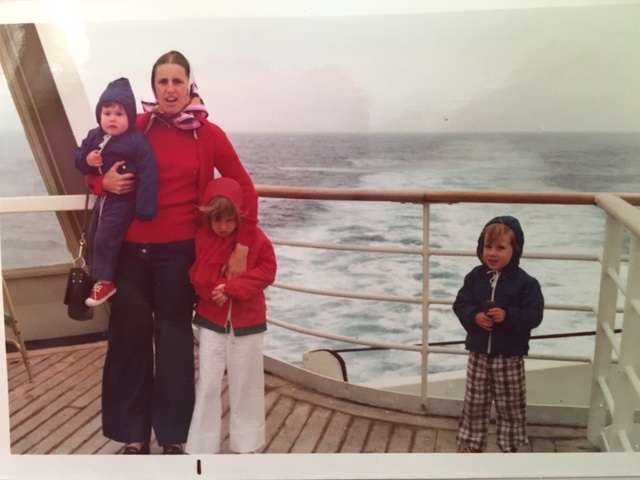
We boarded the Queen Elizabeth 2 on a sunny day.  Unfortunately, once out to sea it was cold and windy.  We spent most of the time indoors.  Our cabin was small with three children and all their paraphernalia.  There were activities for the children during the day.  Most nights there was a dining service for children followed by games and fun.  One night we put the kids to bed early  When they were asleep we crept out, locked the door and went dancing.  When I think about it now and after seeing TITANIC, it seems irresponsible!

Marie-Juliette and the intrepid Volkswagen.

Boarding the QE2. Vincent, Christopher, me, Charles and Marie-Juliette.

There she blows!


Br-r-r.  We all look miserable.
A family dinner complete with sailor hats.


Tuesday, February 9, 2016

Vivent Les Américains


In an earlier post I painted a rose-colored picture of our summers in La Chapelle St. Sépulcre, a tiny village south of Paris near Montargis.  My former mother-in-law, Juliette, was a strong, principled woman.  She was small with bright blue eyes and lovely creamy skin.  During the latter part of the German occupation, she moved from Paris to the village with her three little boys. The house had thick stone walls and a tiled floor.  There was a fireplace and a wood-burning stove but it must have been terribly cold during the long winters of World War II.
             In Paris it had become difficult to procure food for the children.  In the country they could obtain root vegetables and maybe some milk and an egg or two.  The children got tired of the carrots and wormy apples.  Juliette force-fed the toddlers when they refused to eat.  Among the most hated vegetables were salsify and topinambour (Jerusalem artichokes).  Along with the constant hunger and cold was the fear of the German soldiers who could suddenly arrive unannounced in the village.
            In June of 1944, the villagers learned of the Normandy invasion.  Excitement bubbled through the hamlet.   A short time later, there were rumblings that the Germans had begun to flee the approaching Allied Forces.  It was said that the soldiers would grab anything they could; shoot for a loaf of rancid bread or kill for a bicycle.
            One night Juliette put the children to bed and then locked up the house; closed the heavy metal shutters and secured the door.  She fell into a fitful sleep and then awoke in fear.  Outside she could hear footsteps on the gravel, murmurings and undefinable rustling.  She lay there in terror.  In the early light, there was a heavy knock on the wooden door.  With trepidation, she unlocked the door and peeked out.  There towering over her were two American GIs chewing gum and smiling broadly.   The meadow behind the house was sprinkled with tents. Soldiers were busy setting up camp.  In the next few days Juliette and the boys were treated to canned beans, spam, sugar and chocolate.  It was heaven on earth.
            In the weeks that followed, the road that wound through the village became a major supply line for the Allied Forces.  A continual parade of trucks, jeeps and tanks thundered by the house for days on end.  The soldiers would smile, wave and toss out chocolate.

            Until the day she died, Juliette spoke of the Americans with great warmth.  They were indeed her saviors.

The American soldiers pitched their tents in this field behind the house.